
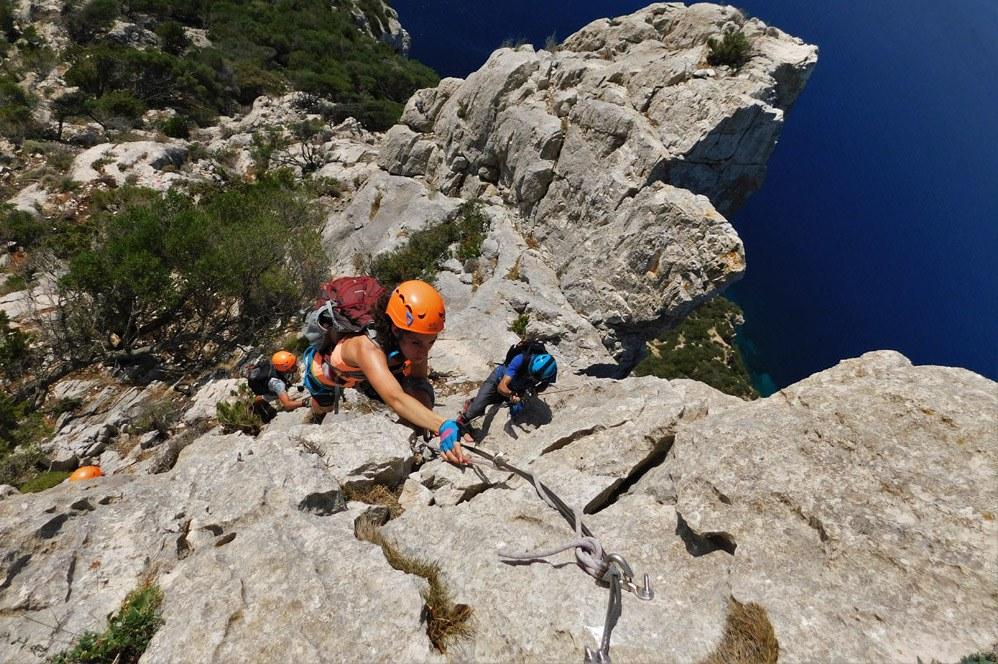
Sardinia is not a land of great via ferratas like the Alps, but it offers protected climbing routes in very different settings: limestone walls inland, ridges overlooking the sea, sea stacks that can only be reached by boat. Precisely because of this variety, before you set off it is important to know which routes are open, which have seasonal restrictions and which are closed.
The short answer is this: today you can climb, among others, the brand-new Ulassai One, the Giorrè via ferrata at Cargeghe, the Regina via ferrata at Monteleone Rocca Doria, the Gutturu Xeu via ferratas at Iglesias, the Pan di Zucchero via ferrata at Masua and the Angeli via ferrata on the island of Tavolara. The Cabirol via ferrata at Capo Caccia and the Medusa via ferrata at Samugheo, on the other hand, are closed.
In this guide you will find the via ferratas that are open, the protected routes to tackle only with a guide, the ones that are closed, and practical advice on how to prepare.
What is a via ferrata and what do you need to climb one?
A via ferrata is a rock route equipped with steel cables, rungs and ladders, to which you stay clipped for the entire ascent. It sits halfway between hiking and climbing: you do not need to know how to climb, but you do need to be sure-footed, free from vertigo and properly equipped.
The minimum kit is a helmet, a harness and a certified via ferrata set with an energy absorber. Via ferratas are not given a grade as in climbing, but a difficulty level: easy, moderate, difficult. The same route can include sections of different levels.
In Sardinia some itineraries are not true via ferratas but mixed protected routes, where the descent requires one or more abseils, that is, descending a rope with a belay device attached to your harness. In these cases you also need a rope, a belay device and the skills to use them, or a guide.
Which via ferratas can you climb in Sardinia?
The status of via ferratas can change from one month to the next because of maintenance work, rockfalls, local ordinances or nesting seasons. The information below is up to date as of November 2026: before you go, always check with the local Municipality or a local guide.
The Giorrè via ferrata, at Cargeghe
The Giorrè via ferrata circles the Giorrè plateau, in the territory of Cargeghe, along a route of about 2.5 kilometres. It is currently open. Along the way there are two short abseils, of about 16 and 20 metres: the second is a little more technical, because it includes a short free-hanging section.
Few people know what lies at the end: on the upper plain stands the Nuragic sanctuary of Giorrè, in the territory of Florinas, which is worth a visit in its own right.
Nesting restrictions: the final section, the highest ledge, is closed every year in spring to protect the birds of prey that nest on the cliff, including the peregrine falcon; the stated period runs from March to mid-June. During those months, check beforehand with the Municipality of Cargeghe which part of the route is open, and follow the signs on site.
Why go: a long, panoramic route that ends close to a Nuragic archaeological site.
Where it is: Cargeghe, province of Sassari, north-western Sardinia.
The Regina via ferrata, at Monteleone Rocca Doria
This via ferrata climbs the rock face above the village of Monteleone Rocca Doria, overlooking Lake Temo. It is accessible and considered one of the best-maintained via ferratas in Sardinia. It is graded as difficult, but the difficulty is concentrated in the opening section: climbed in reverse, the via ferrata becomes moderately difficult, if not easy.
Why go: a well-kept route with views over the lake and the village.
Where it is: Monteleone Rocca Doria, province of Sassari, north-western Sardinia.
The Angeli via ferrata, on the island of Tavolara
On the island of Tavolara, the Angeli via ferrata climbs along the ridge, but does not lead directly to the summit: you can finish at the end of the vertical section with two abseils, or continue for about 500–600 metres over rock to Punta Cannone, the highest point of the island.
A second ascent, separate from the via ferrata, also leads to Punta Cannone, starting from the beach of Spalmatore di Terra. It is easier and not exposed: it climbs moderate slopes, almost entirely over scree.
With ordinance no. 28 of 13 May 2025, the Municipality of Olbia had banned the ascent to the summit; on 19 May 2025 the ban was limited to 30 September 2025. Today the ascent to Punta Cannone is open again and no new bans have been reported, but the rules may change: before planning your outing, check with the Municipality of Olbia. The start of the Angeli via ferrata is hidden and hard to find if you do not know the area: a guide is recommended.
Why go: the view from above over the island and the Gallura coast.
Where it is: island of Tavolara, Olbia, north-eastern Sardinia; reached by boat from Porto San Paolo, or by private dinghy services departing from Cala Finanza.
The Pan di Zucchero via ferrata, at Masua
The Pan di Zucchero is the limestone sea stack off the beach of Masua and is a Natural Monument. The via ferrata can only be reached by sea, by boat or dinghy, and only when the sea is calm. A guide is not compulsory, but the marine setting and the boat access make it suitable for those who already have experience. Those experienced in abseiling can return from the via ferrata with a 45-metre abseil straight down to the sea, arranging beforehand for the dinghy pilot to wait for them at the base.
Nesting restrictions: to protect the Audouin's gull, the ascent is prohibited from 1 to 30 June. Before planning your outing, check the rules in force with the Municipality of Iglesias.
Why go: climbing a sea stack in the middle of the sea is a rare experience.
Where it is: Masua, Iglesias, south-western Sardinia.
The Gutturu Xeu via ferratas, at Iglesias
In the Gutturu Xeu area, in the territory of Iglesias, there are two different via ferratas, both in good condition.
Why go: two difficulty levels in the same area.
Where they are: Iglesias, south-western Sardinia.
Ulassai One, the newest via ferrata
Ulassai One is the newest via ferrata in Sardinia: it lies a few minutes from the village centre and was opened by the Municipality of Ulassai in spring 2025 (Source: Municipality of Ulassai – Ulassai Festival 2025). It is short, still little known and suitable for almost everyone, with just one brief section of moderate-to-high difficulty.
Why go: a first taste of via ferratas, in the landscape of the Tacchi d'Ogliastra.
Where it is: Ulassai, Ogliastra, central-eastern Sardinia.
La Contea di Rena adventure park, at Arzachena
If you want to try a via ferrata for the first time, there is also La Contea di Rena, a private adventure park at Arzachena. It has a via ferrata with several easy levels and, alongside it, a Tibetan bridge, a military bridge and four zip lines. Equipment is provided on site.
Why go: a first taste of via ferratas in a controlled setting.
Where it is: Arzachena, Gallura, north-eastern Sardinia.
Which protected routes should only be tackled with a guide?
Some itineraries are not true via ferratas but protected routes in wild terrain, where abseils are an important part of the outing. They should only be tackled with a guide.
Punta Plumare, at Baunei
This is a demanding, poorly maintained and very wild route, done mainly for its abseils. It should only be tackled with a guide qualified for both via ferratas and abseiling.
The Ledere di Goloritzé, at Baunei
This is a protected route exposed above the sea, in the Cala Goloritzé area. It is very dangerous: the fixed equipment is old, the itinerary is hidden and finding the way out is difficult if you do not know the area well. It should only be done with an experienced guide.
Where they are: Baunei, Ogliastra, east coast of Sardinia.
Badde Pentumas, at Oliena
This is a mixed route, part protected trail and part via ferrata, with several abseils, in the Supramonte of Oliena. It should only be done with a guide.
Where it is: Oliena, province of Nuoro, central-eastern Sardinia.
Which via ferratas are closed?
The Cabirol via ferrata, at Capo Caccia
The Cabirol via ferrata, on the cliffs of Capo Caccia in Alghero, has been closed since 2018 by municipal ordinance and has never reopened. The original cables were removed and illegally replaced with ropes: the route is not safe and must not be attempted. Many web pages still describe it as open, but this is not the case.
The Medusa via ferrata, at Samugheo
The via ferrata leading up to Medusa Castle, at Samugheo, is also closed and must not be attempted.
Beware of unofficial via ferratas: in Sardinia there are protected routes built without authorisation, some of which have already been dismantled. If a route has no managing body or official opening, consider it unsafe.
How to prepare for a via ferrata in Sardinia
- Check the weather, especially for thunderstorms: in summer, storms can build quickly. On a via ferrata the steel cable can act like a lightning conductor, and staying clipped to it is dangerous: if the weather turns, give up or turn back.
- Avoid wet rock: in rain or high humidity, the rock and the metal fittings become extremely slippery.
- Check the route's status before you go: ask the Municipality or a guide whether the route is open. An old web page is no proof that a via ferrata is open.
- Respect nesting seasons: Giorrè and the Pan di Zucchero have seasonal bans. Follow the signs on site.
- Bring the full kit: helmet, harness and a certified via ferrata set; for routes with abseils, also a rope, a belay device and the skills to use them.
- Check the sea and wind: in rough seas, boat access, as at the Pan di Zucchero and Tavolara, can become impossible.
- Consider a guide: it is the safest choice if you have no experience, if the route is in a marine setting or if the start is hard to find.
Experience outdoor Sardinia with Milena Suite Apartments
Sardinia's via ferratas let you discover the island from a different perspective, between inland rock faces and ridges above the sea. Knowing their status, the right seasons and your own limits is the first step to enjoying them safely.
Milena Suite Apartments invites you to plan your next stay in Sardinia and discover the experiences the island offers in every season.
Discover Milena Suite Apartments and check availability for your next stay.
Sources
- Municipality of Ulassai – Ulassai Festival 2025
- Municipality of Olbia – Ordinanza n. 28/2025
- SardegnaTurismo – Pan di Zucchero e faraglioni di Masua
- Corrado Conca, Vie ferrate in Sardegna, Edizioni Segnavia, 2023
Planning a stay in Alghero?
Milena Suite Apartments is a 5-minute walk from Maria Pia Beach. Book directly and save up to 20%.
Check availability